Sunday, August 16, 2015

Oregon, Alabama, and the Great State of Texas

After two months of travel across the United States some thanks are in order for the reception and support that we have received.  Your advice, financial support, and expertise have given us the tools that we needed to continue to run AC4D for the benefit of Jordan Valley farmers and refugee families across northern Jordan.        


In Oregon the Christmas Valley farming community proves the power of faith centered cooperation to bring the agricultural community together for the benefit of all.  Your example has influenced our belief that collective action is the cornerstone of agricultural development. 

In Alabama, Cattle for Christ International and Mission Driven Research (with its affiliate) taught us that the best solutions for capacity development are developed cooperatively. 

In Texas a bunch of old Aggies reminded us to stay true to who we are and to work hard in the service of others. 

Thursday, June 18, 2015

The Example of George Washington Carver


Synopsis

George Washington Carver was born into slavery in Diamond, Missouri, around 1864. Carver went on to become one of the most prominent scientists and inventors of his time, as well as a teacher at the Tuskegee Institute. Carver devised over 100 products using one of these crops—the peanut—including dyes, plastics and gasoline.

Early Years

Botanist and inventor George Washington Carver was one of many children born to Mary and Giles, an enslaved couple owned by Moses Carver. He was born during the Civil War years, most likely in 1864. A week after his birth, George was kidnapped along with his sister and mother from the Carver farm by raiders from the neighboring state of Arkansas. The three were sold in Kentucky, and among them only the infant George was located by an agent of Moses Carver and returned to Missouri.
 
The conclusion of the Civil War in 1865 brought the end of slavery in Missouri. Moses Carver and his wife, Susan, decided to keep George and his brother James at their home after that time, raising and educating the two boys. Susan Carver taught George to read and write, since no local school would accept black students at the time.

The search for knowledge would remain a driving force for the rest of George's life. As a young man, instead of attending classes, he homesteaded a claim, where he conducted biological experiments and compiled a geological collection. His aptitude for drawing the natural world enabled him to enroll in the botany program at the Iowa State Agricultural College.

Carver moved to Ames and began his botanical studies the following year as the first black student at Iowa State. Carver excelled in his studies. Upon completion of his Bachelor of Science degree, Carver's professors persuaded him to stay on for a master's degree. His graduate studies included intensive work in plant pathology at the Iowa Experiment Station. In these years, Carver established his reputation as a brilliant botanist and began the work that he would pursue for the remainder of his career.

Carvers work

After graduating from Iowa State, Carver embarked on a career of teaching and research.  Carver was hired to run the school's agricultural department in 1896.  Areas of research and training included methods of crop rotation and the development of alternative cash crops for farmers in areas heavily planted with cotton. This work helped struggling sharecroppers in the South, many of them former slaves now faced with necessary cultivation under harsh conditions, including the devastation of the boll weevil in 1892. The development of new crops and diversification of crop use helped to stabilize the livelihoods of these people who had backgrounds not unlike Carver's own.

The education that Carver provided contributed directly to the effort of economic stabilization among blacks. In addition to formal education in a traditional classroom setting, Carver pioneered a mobile classroom to bring his lessons to farmers. The classroom was known as a "Jesup wagon," after New York financier Morris Ketchum Jesup.

Rise to Prominence

Carver's work included groundbreaking research on plant biology that brought him to national prominence. Many of these early experiments focused on the development of new uses for crops such as peanuts, sweet potatoes, soybeans and pecans. The hundreds of products he invented included plastics, paints, dyes and even a kind of gasoline. In 1920, Carver delivered a speech before the Peanut Growers Association, attesting to the wide potential of peanuts. The following year, he testified before Congress in support of a tariff on imported peanuts. With the help of Carver's testimony, the proponents of the tariff were able to institute it in 1922.

By the time of his testimony Carver had already achieved international fame in political and professional circles. President Theodore Roosevelt admired his work and sought his advice on agricultural matters in the United States.  In 1916, he was made a member of the British Royal Society of Arts and he regularly advised Indian leader Mahatma Gandhi on matters of agriculture and nutrition.

George Washington Carver died on January 5, 1943, at the age of 78. His epitaph reads: "He could have added fortune to fame, but caring for neither, he found happiness and honor in being helpful to the world."

-Taken from Biography.com

Sunday, May 24, 2015

Looks like we win: 36 to 11

Soil salinity reports for the parcel of the farm which was deep plowed and planted in Barley to encourage rainwater infiltration and salt uptake came in yesterday.  When we began the intervention soil was sampled and tests returned 36 ds/m in electroconductivity.  To put that number in perspective, it is roughly eight times the recommended level for vegetable crops and we were informed that only by irrigating with drinking water could we reasonably expect any productivity.  To put it mildly, the land was highly saturated with salt from the use of saline irrigation water.

The tests recently returned show the amount of salt dropped to 1/3rd its previous level after a single wet season, from 36 to 11ds/m.  This drastic reduction serves as proof of concept for our soil rehabilitation strategy and it bodes very well for next years harvest.


Friday, May 22, 2015

Farmer Feedback from First Year

The AC4D team held a stakeholder meeting and end of year evaluation this past week.  We brought in a pest management expert to discuss preventative pest management, discussed successes during the season and opened the time to farmers to direct the trials and demonstrations that we will undertake next year.

Key findings included several different new varieties that are growing well under Middle Ghor conditions as well as widespread requests for organic vs in-organic fertilization at the beginning of the season while planting.  About 20 farmers were in attendance.  Working groups were formed to discuss issues of importance in our area as well as to solicit feedback from our first years efforts.  Following the seminar and working groups everyone stayed for lunch.  After a long and exhausting season it was great to enjoy time with all of the people who made our trial and demo farm a success. 

One of the working groups


Operation Mercy Director Bob Cole was in attendance
 

Tuesday, May 5, 2015

Funding of Crucial Equipment by Australian Embassy

The Agricultural Cooperation for Development staff would like to extend our thanks to the Australian Embassy in Jordan for their farsighted contribution of greenhouses to our Jordan Valley demonstration farm.  These greenhouses are allowing us to demonstrate high value tomato, cucumber, and eggplant varieties to local farmers in support of our community development goals. 

Greenhouses being disassembled for transport

Greenhouses after assembly at the demo farm
Irrigation Pond and Pump Stand

Monday, April 6, 2015

Vehicle Purchase

AC4D extends a very warm thanks to Cattle for Christ International for their generous and far-sighted contribution to purchase a vehicle in support of our Jordan Valley demonstration farm. 

Since this picture was taken we added a highwall truck box to allow us to haul over 130 boxes of produce at a time.  This capability currently saves us about $1000 per month in delivery fees. 

Sunday, April 5, 2015

Trying Times for Jordanian Farmers


About a week ago I watched as our neighbor Musa, the Eggplant Master of the Middle JV, ran across his field.  This was odd as I have never seen a farmer run.  Farmers don’t run, we work at the speed of plants and we change with seasons.  Sound planning, repetition and consistency are our major allies and rarely, if ever, does being in a rush get you anywhere that you want to be.  I shouted to Musa from across our irrigation pond, “What are you doing!?”  In a mixture of disbelief and joy he shouted back, “Eggplant is 2JD ($2.80) a box at the Market in Sueilah!”  In a flurry of activity he and his workers picked half of an agricultural unit (the sum total of the amount that AC4D has planted this year) entirely clean yielding Musa about 200 large boxes of eggplant which he took immediately to market. 

This story is an excellent window into market conditions this season as we wind down.  Farmers will tell you in the deepest confidence that they break even at about 1.5JD per box.  The wholesale market has offered less than that to farmers for significant portions of this winter and spring making even harvesting produce from the field a gamble.  Hiring workers, buying boxes, ferrying produce to market en masse, and paying commissions mean incurring additional costs but with at least the hope of returning some of the farmers initial investment.  How much of that investment and what, if any, profit can be expected under current market conditions is the big question.  Musa had some inside information that he could likely make .5 JD (70 cents) per box in net profit and was so enthused that he picked his biggest field clean in a heated rush in the hopes of making 100JD ($180).  In a follow up conversation Musa concluded that he would likely not make any net profit this season after a 30% commission to the land owner that he works with. 

How can I encapsulate conditions for Jordanian farmers this season?  In a word, abysmal.  The major reasons behind the vegetable market price collapse of the last 3 years in the Jordan Valley have to do with regional conditions.  Before the latest iterations of the wars in Syria and Iraq farmers took top dollar for high quality produce that was exported and received lesser returns on class b produce for the Jordanian market.  Since the border closures to Syria and Iraq Jordanians are now unable to export to both of those major markets as well loosing land route access to Turkey and Europe.  The closure of international markets has created a glut of high quality produce within Jordan driving down prices on even the best quality vegetables and fruit and leaving class b produce with no market at all. 

In response to these conditions, in addition to our trial and development work, AC4D will be focusing some of its efforts in the coming year on developing direct links between farmers and consumers to cut out wholesalers, raising revenue for smallholders.       

Monday, March 23, 2015

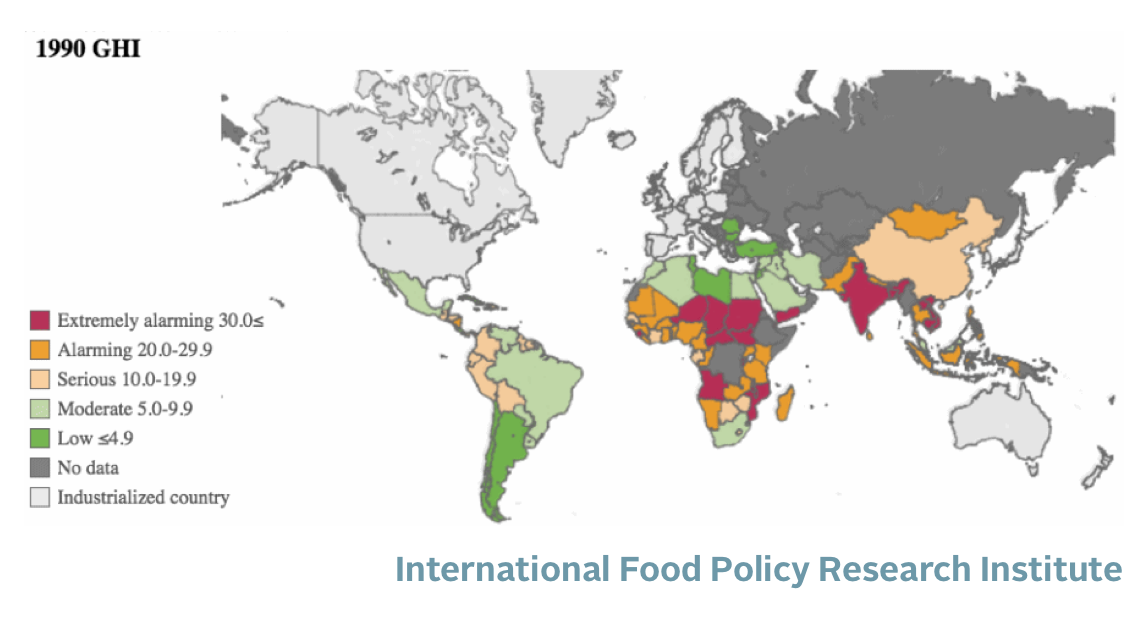
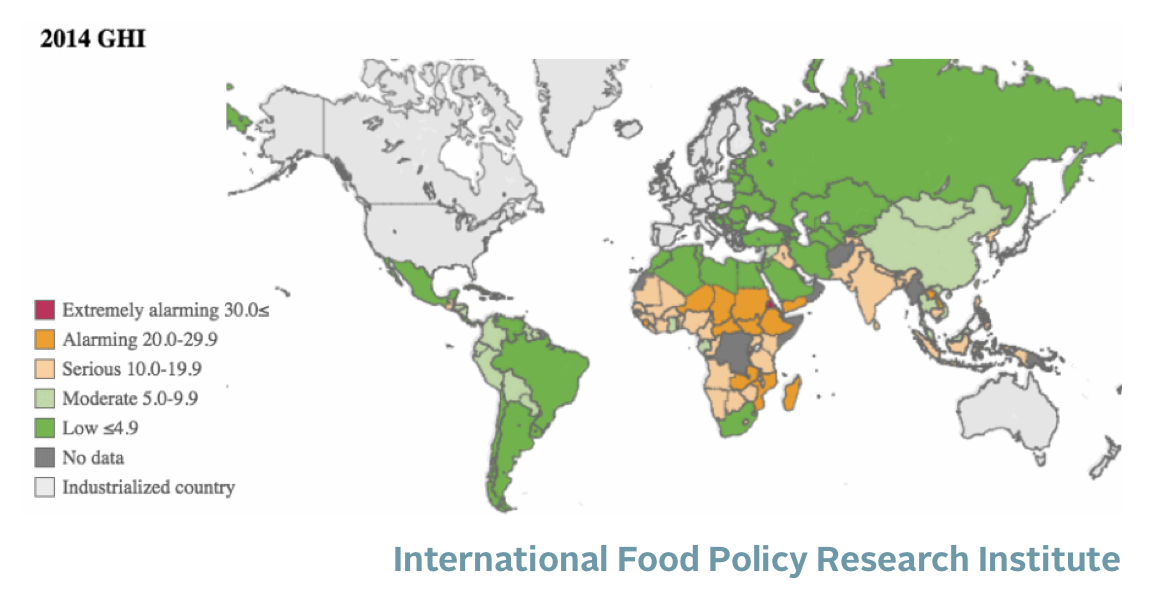
Apparently we are doing a great job reducing hunger !

According to the International Food Policy Research Institute the world is doing an increasingly good job of reducing hunger and extreme poverty.  I am sure that we can find plenty of differences of opinion as to how that feat is being accomplished.  My money is on smallholders getting better access to nitrate fertilizer and improved varieties of staple crops like wheat and rice.  Better productivity near where food is consumed reduces waste, price, and spoilage in transit while increasing local revenue and the percentage of food consumed.  

World Food Security Overview in 1990


World Food Security Overview in 2014


Source for the above maps
 http://www.ifpri.org/tools/2014-ghi-map


Tuesday, March 3, 2015

Healing Relationships Video

Here is a video explaining some of the community building aspect of Operation Mercy's work in the Jordan Valley. 

Interview with the Ag. Projects Manager in Jordan

Sunday, March 1, 2015

Bill Gates and I Agree on GMOs

Mr. Gates highlights some of the most salient points affecting smallholder farmers and the benefits of using GMO (genetically modified) crops in a brief video on The Verge.  Using GMOs the United States currently feeds its own population of 300 million and remains a major food exporter.  So much so that about one third of all US agricultural income comes from exports. One of the major tools used by the vast majority of American farmers are GMO crops. 


 Here is a link to the video explaining how GMOs effect food production in the developing world.

http://www.theverge.com/2015/2/18/8056163/bill-gates-gmo-farming-world-hunger-africa-poverty